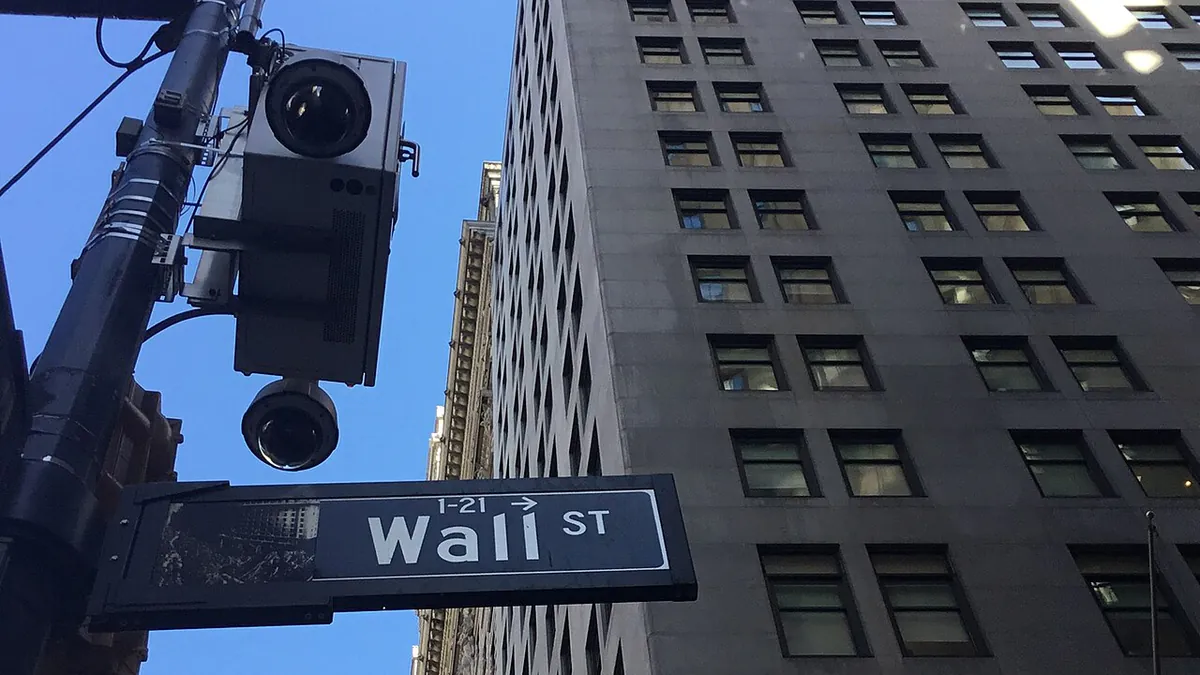
The stock market in one sentence
The stock market is the network of exchanges and brokers where people and institutions buy and sell shares: small slices of ownership in public companies. When you buy one share of a company, you own a tiny fraction of that business, including a claim on its future profits.
When news reports say "the market rose today", they almost always mean a stock index, such as the S&P 500, went up. More on indexes below.
Why companies sell shares
A growing company needs money to hire people, build products and expand. It can borrow (take loans or sell bonds) or it can sell part of itself to investors. Selling ownership is called raising equity.
Young companies raise equity privately from founders, angel investors and venture capital funds (see our guide to how startup funding works). When a company wants access to a much bigger pool of investors, it lists its shares on a public exchange through an initial public offering (IPO).
The IPO is the only moment most investors' money goes directly to the company. After that, nearly all trading is between investors: when you buy a share of a big company through an app, you are almost always buying it from another investor, not from the company.
Primary and secondary markets
- Primary market: where new shares are created and sold for the first time, as in an IPO or a follow-on offering. The company receives the money.
- Secondary market: where existing shares change hands every day. This is what people normally mean by "the stock market". The company does not receive money from these trades, but its share price still matters: it affects how cheaply it can raise money later, what its stock-based pay is worth and how easily it can buy other companies with its shares.
Where stocks are traded
A stock exchange is a regulated marketplace that matches buy and sell orders. The best known:
- United States: the New York Stock Exchange (NYSE) and Nasdaq. Regular trading runs from 9:30 a.m. to 4:00 p.m. Eastern Time on weekdays, with extended-hours sessions before and after.
- India: the National Stock Exchange (NSE) and the Bombay Stock Exchange (BSE).
- Elsewhere: the London Stock Exchange, Tokyo Stock Exchange, Euronext, Hong Kong and others.
Today almost all trading is electronic. Ordinary investors reach the exchanges through a broker, usually a trading app or brokerage website. Markets are overseen by regulators: the Securities and Exchange Commission (SEC) in the U.S., the Securities and Exchange Board of India (SEBI) in India, and the Financial Conduct Authority (FCA) in the U.K. They set rules on disclosure, insider trading and how brokers treat customers.
How a trade actually happens
- You place an order in your brokerage app: which stock, how many shares and what type of order.
- The order is routed to an exchange or other trading venue.
- It is matched with someone willing to take the other side at a compatible price.
- The trade settles: cash and shares formally swap owners. In the U.S. and India, most stock trades now settle one business day after the trade (called T+1).
The two most common order types:
- Market order: buy or sell right away at the best price available. Fast, but the price can be slightly worse than the last quote, especially for thinly traded stocks.
- Limit order: buy or sell only at a set price or better. You control the price, but the order may never fill.
Every stock has a bid (the highest price a buyer is offering) and an ask (the lowest price a seller will accept). The gap between them is the spread. Large, popular stocks usually have spreads of a cent or two.
What makes stock prices go up and down
At its simplest, a price moves when there are more eager buyers than sellers (up) or more eager sellers than buyers (down). Behind that, the main driver is what investors expect a company to earn in the future, and how much they are willing to pay today for those future earnings.
That is why a company can report record profits and still see its stock fall: if investors expected even more, the news is a disappointment. Interest rates, the economy, industry trends and plain investor mood all play a part too. We go deeper in what moves stock prices.
What indexes like the S&P 500 and Dow measure
There are thousands of listed companies, so investors use indexes, baskets of stocks tracked as one number, to see how the market is doing.
| Index | What it tracks | How it is weighted |
|---|---|---|
| S&P 500 | About 500 large U.S. companies | By market value: bigger companies count more |
| Dow Jones Industrial Average | 30 large U.S. companies | By share price: higher-priced stocks count more |
| Nasdaq Composite | Nearly every stock listed on Nasdaq, heavy in technology | By market value |
| Nifty 50 / Sensex | 50 large NSE companies / 30 large BSE companies (India) | By free-float market value |
Market value (or market capitalization) is the share price multiplied by the number of shares. A company with 1 billion shares at $50 is worth $50 billion on the market.
Many people invest in indexes directly through index funds and exchange-traded funds (ETFs), which hold every stock in an index. That gives instant diversification at low cost.
Bull markets, bear markets and corrections
- Bull market: a long stretch of rising prices, usually with optimism about the economy and profits.
- Correction: a fall of 10% or more from a recent high. Corrections are common and often short.
- Bear market: a fall of 20% or more from a recent high, often tied to a slowing economy or a recession.
Historically, broad stock markets have gone through many corrections and bear markets and still risen over long periods. That history is no guarantee, and individual stocks can fall to zero, which is why diversification matters.
How investors make (and lose) money
- Price gains: selling a share for more than you paid (a capital gain).
- Dividends: some companies pay part of their profits to shareholders, usually every quarter.
- Losses: if the price falls below what you paid and you sell, you lose money. A company that goes bankrupt can leave its shareholders with nothing.
Stocks have historically offered higher long-term returns than savings accounts or bonds, but with much bigger swings along the way. That trade-off between return and risk is the core idea behind almost every investing decision.
Key terms to know
- Ticker: a stock's short code, like AAPL for Apple.
- Volume: how many shares traded in a period.
- Volatility: how sharply a price swings.
- P/E ratio: share price divided by earnings per share; a rough gauge of how expensive a stock is.
- Blue chip: a large, established, financially strong company.
- Portfolio: all the investments one person or fund holds.